Now is the time to begin researching the barriers to be tackled in the next Accelerated Infrastructure Delivery Plan – this was the key action suggested by the NESC Secretariat at the IGEES Strategic Policy Seminar held in the Department of Public Expenditure, Infrastructure, Public Service Reform and Digitalisation.
Dr Cathal FitzGerald, Senior Analyst at NESC, told the gathering that research is needed on cultural, behavioural, and political barriers in the policy system.
“The current Accelerated Infrastructure Delivery Plan can rightly tackle legal, planning, regulatory, social, and operational barriers, and should be implemented without delay,” Dr FitzGerald said. “However, Ireland’s persistent problem in delivering infrastructure across many sectors suggests that there are other issues at play.”
Dr. FitzGerald was invited to present on this recent paper Addressing Trade-Offs in the Energy Transition. “From Ireland’s frustrating progress in the energy transition, there is good reason to believe that other factors sit alongside well-understood barriers to delivery such as planning delays,” he told the event. “Ireland never devised a pathway for an energy system that is simultaneously sustainable, secure, affordable, competitive, and socio-politically acceptable. Despite thirty years of ever-higher targets.”
“First among these must be the persistent failure to confront policy trade-offs. This problem can lead to increased ambiguity, incoherence, uncertainty, and risk. It can result in short-termism, unattainable targets, and store problems up for the future,” Dr. FitzGerald said. “This just makes subsequent decisions even harder, generates disillusionment and cynicism, reduces faith in the system, and polarises debate,” he suggested. “There can be a shift in focus to ‘what is needed’ as opposed to ‘what can actually be delivered’ but this can actually reduce the ability to deliver.” he added.
As well as the failure to resolve trade-offs, Dr. FitzGerald suggested some other cultural, behavioural, and political barriers which warranted exploration in the near-term. “New research would be helpful into a range of potential barriers, such as poor policy dialogue, inconsistent policy positions, low alignment capacity at the centre of Government, the impact of political competition, and cognitive dissonance,” he noted. Finally, “some empirical work on rational risk aversion and proceduralism which may contribute to policy sclerosis and cynicism would also be helpful,” he concluded.
Dr FitzGerald’s presentation is available here.
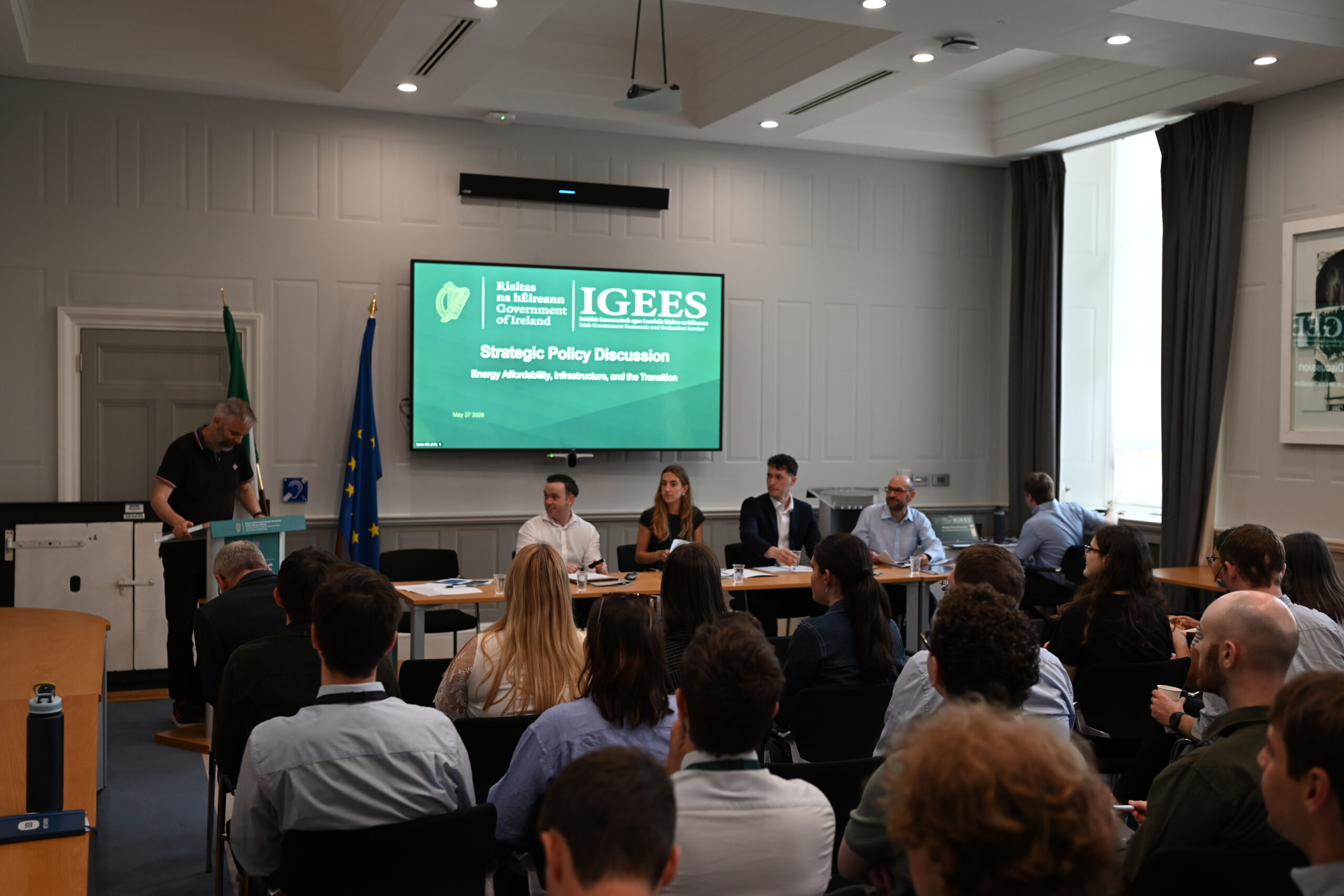
Photo caption: IGEES Strategic Policy Seminar, May 27th, 2026. Dr Cathal FitzGerald, Senior Analyst at NESC (seated far right) presented on accelerating infrastructure delivery.