You are here: Home > News & Events > Council Report No.171 – Building a Virtuous Demographic Cycle
Council Report No.171 – Building a Virtuous Demographic Cycle
- 29 December 2025
- Topics: Social
- Types: Press Releases
NESC report shows substantial demographic changes are inevitable, but they can be shaped
- The number of children is falling due to declining birth rate.
- In the next decade we might see a fall in the number of workers.
- To maintain a healthy balanced demographic cycle Ireland needs to welcome migrants.
29th December 2025, Dublin, Ireland: A new research report published by the National Economic and Social Council (NESC) examines the impact of demographic changes on Ireland. Ireland is undergoing a series of demographic shifts and has already passed two notable turning points: ‘peak baby’ in 2010 and ‘peak child’ in 2024, both reflecting a sharp and sustained fall in births. Because of this Ireland will reach peak population in approximately three decades.
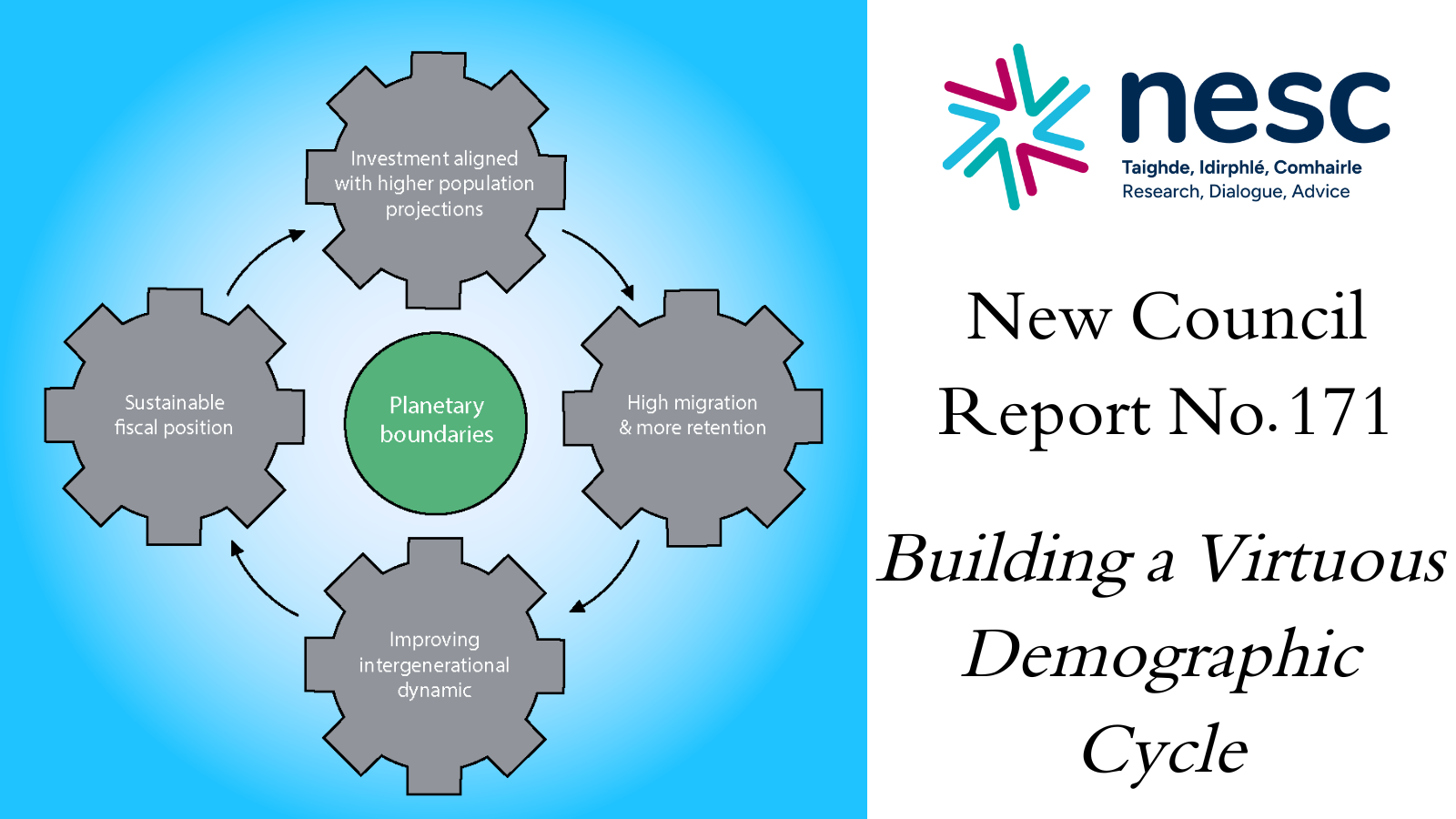
This will mean an ageing population, and each year Ireland is getting older. There are also substantial regional variations to these demographic changes. Ireland risks a downward vicious cycle where we have insufficient workers, therefore insufficient tax revenues to support our ageing population and insufficient investment in our infrastructure.
The NESC report highlights that rather than a downward cycle Ireland could shift to a healthier and more balanced cycle – where birth rates are supported, participation in the labour force is increased, our health services are reconfigured to support early intervention and community-based interventions. At the same time, we spread the benefits of demographic dynamism, and we can prepare fiscally for future changes in population..
“Demographic change is inevitable, but it does not have to be destabilising. It is a signal to plan ahead to create the country we want to live in. By acting now, we ensure that future generations inherit a social model that is resilient, sustainable, and genuinely inclusive,” said Dr Gráinne Collins Policy Analyst at NESC. “Ireland has already crossed two demographic thresholds — peak baby and peak child — marking a decisive shift from population expansion to gradual population ageing; we therefore need to prepare economically and socially for the other demographic changes that are coming,” she stated.
NESC makes several recommendations to prepare for demographic change. These include:
- First, Ireland needs to invest in demographic modelling and research into the motives that affect demography such as the decision to have a baby or to emigrate.
- Second, Ireland should prepare for the high estimates of population growth and recalibrate as necessary.
- Third, NESC reveals the need to coordinate policies across a wide range of areas to ensure that demographic changes become a source of strength.
- Fourth, the NESC Council finds that while many policies are in place much more ambition and resources are needed to ensure that the policy goal is achieved.
Dr Grainne Collins added:
“Too often Ireland has been looking at population change in the rear-view mirror, we need to become better at modelling and anticipating changes and preparing for them.”
On the publication of the report, Dr Larry O’Connell, Director of NESC, added that:
“Ageing, falling fertility and shifting migration patterns are reshaping societies across Europe, and Ireland is no exception. While Ireland has undergone remarkable change in recent decades, it would be unrealistic to assume this pace can continue indefinitely. Demographic trends will shape living standards, labour markets and the sustainability of public finances for many years to come, and a rapidly ageing population will place growing pressure on our care systems.
“Long-term planning is therefore essential as we confront these profound shifts. With a positive and ambitious approach, Ireland can ensure that demographic change becomes a springboard for a more cohesive and inclusive society.”
To read the report in full please click here.
ENDS
For further information, contact:
Marie Lynch, Carr Communications,
e: marie@carrcommunications.ie | m: 087 973 0522


