
Research Area: Housing & Land Use

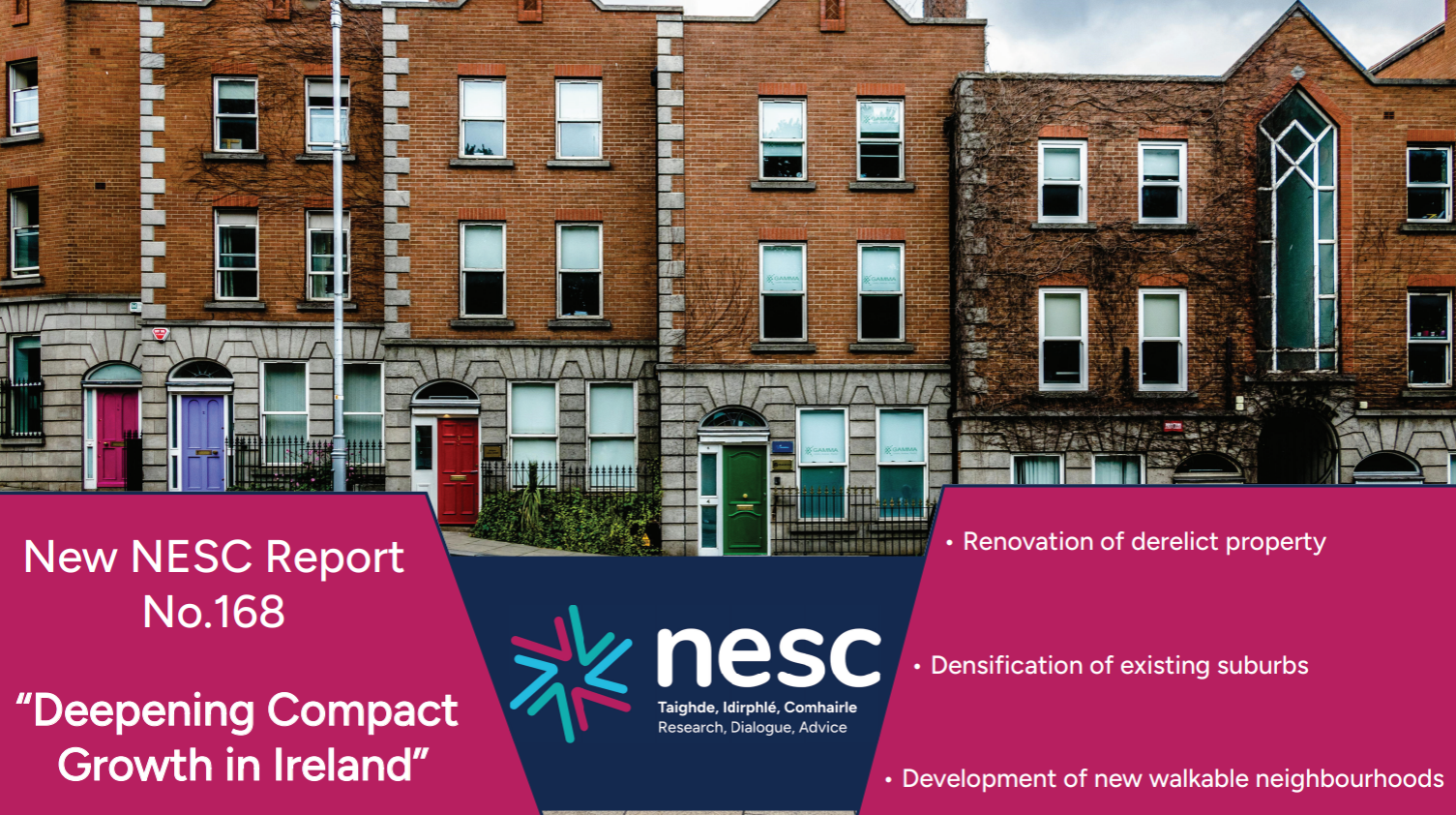
  • Council Report No.168, ‘Deepening Compact Growth in Ireland’ – Major benefits to compact growth but factors working against it

    Council Report No.168, ‘Deepening Compact Growth in Ireland’ – Major benefits to compact growth but factors working against it

    • More investment needed to unlock land suited for compact growth.
    • Facilitate more use of corner sites, gardens, backlands, and mews developments.
    • Review codes, regulations, and incentives that affect brownfield development.

    The first goal of the recently published Draft National Planning Framework (NPF) is compact growth. NESC has published a new report, Deepening Compat Growth in Ireland, which looks at the benefits of compact growth but also the factors working against it.

    Compact growth means having more growth within the boundaries of cities, towns, and villages, and the development of new walkable neighbourhoods served by frequent public transport.

    Speaking on the publication of the Compact Growth report, Dr Larry O’Connell, Director of NESC, highlighted the many advantages to compact growth“It means better access to services, more sustainable travel, and a reduction in the cost of public services and infrastructure.” He noted that studies also show that compact growth in urban centres increases productivity and innovation. “Compact growth also helps reduce carbon emissions and delivers other environmental gains,” he concluded.

    Noel Cahill, economist with NESC, pointed out that despite the advantages of compact growth, there are pressures working against it“The search for affordable housing often leads people to buy houses in areas far from where they work and that are car dependent.” He also highlighted that brownfield development, which replaces existing commercial or residential development, tends to be more costly for developers than greenfield development on sites where there was no previous development.

    The report shows that the NPF target – that 40 per cent of new housing development within the existing built-up areas of cities, towns, and villages – is being achieved. However, it argues that this target is a modest one and that it continues to be the case that the fastest growth is at the edges and outside of towns and cities.

    NESC makes several recommendations to make more progress on compact growth. These include:

    • Increasing public investment to unlock land for compact growth, including major urban transformation projects and investment in infrastructure for housing in towns and villages;
    • Placing more emphasis on the densification of existing areas to facilitate more use of corner sites, gardens, backlands, and mews developments; and
    • Developing a brownfield activation strategy that includes review of the most important codes, regulations, and incentives that affect brownfield development.


    To read the report in full, please click here.

    ENDS.


    For further information, contact:

    Marie Lynch, Carr Communications,

    e: marie@carrcommunications.ie | m: 087 973 0522

  • Deepening Compact Growth in Ireland

    Deepening Compact Growth in Ireland

    Ireland’s sprawling pattern of development has long been of concern for economic, social, and environmental reasons. It results in higher costs of providing public services and infrastructure. It also leads to high car dependency to meet daily needs. Ireland’s long-term spatial plan, the National Planning Framework, sets out an alternative vision based on compact growth.

    Compact growth means having more growth within the boundaries of cities, towns, and villages, as well as the development of new walkable neighbourhoods. It includes the renovation of vacant and derelict property. More apartments contribute to compact growth but are not synonymous with it. The Council welcomes the provisions in the 2024 Sustainable Residential Development and Compact Settlements Guidelines for Planning Authorities that provide for more compact ‘own door’ housing in appropriate locations.

    An extended version of this report, in the form of a secretariat paper, can be read by clicking here.

  • Deepening Compact Growth in Ireland: Extended Research

    Deepening Compact Growth in Ireland: Extended Research

    This Secretariat paper was prepared in conjunction with the Council report of the same name, Deepening Compact Growth in Ireland, No.168. There is overlap between the two documents.

    Compared to the Council report, this Secretariat paper has more extensive discussion of the following topics: the costs and benefits of compact growth (Chapter 3), vacant and derelict property (Chapter 6), and international examples of compact development (Chapter 7).

  • Boosting Ireland’s Housing Supply: Modern Methods of Construction

    Boosting Ireland’s Housing Supply: Modern Methods of Construction

    The need to boost housing supply has led Irish policy-makers, the construction sector and housing market interests to become increasingly focused on modern methods of construction (MMC). As an umbrella term, ‘MMC’ refers to technological advances, new product developments and building systems being delivered through increased digitalisation and emerging technologies. Materials and systems used in buildings must comply with the Building regulations and be fit for their intended use and conditions in which they are to be used. The distinct characteristic of MMC is the offsite manufacture (OSM) of buildings and their components in a factory setting and their follow-on transportation, onsite assembly and fabrication.

    This report investigates the potential of MMC to significantly boost housing supply. It highlights progress under the MMC roadmap, an important and ambitious State policy designed to achieve greater adoption of MMC, which is of a high quality and complies with Building Regulations, in public housing delivery and in the housing system more widely.

    Drawing on primary research, investigation and dialogue among key stakeholders, the report examines the benefits and challenges associated with MMC. It finds that greater adoption of MMC for residential development can be a ‘game changer’ for the Irish housing system, as it can drive higher productivity gains, substantially increase housing supply, and help meet the environmental goal of decarbonising housing – both new and existing stock.

    Key findings in the report:

    1. MMC can boost Ireland’s new housing supply and help meet climate targets through more sustainable use and circular re-use of materials in construction;
    2. Greater adoption of MMC can lead to higher productivity gains in Irish homebuilding;
    3. Ireland’s MMC  industry is ready, willing, and able to increase housing supply and accelerate delivery; and,
    4. Increased use of MMC in homebuilding helps meet Ireland’s environmental goal of decarbonising housing delivery.

    This report identifies three developmental opportunities that can deliver positive transformation and result in a more productive, cost-effective and environmentally sustainable construction sector in Ireland:

    1. Expand the use of MMC by established Irish homebuilders to capture its productivity and environmental benefits, especially for timber-based MMC.
    2. Increase inward investment by international MMC companies.
    3. Grow Irish MMC businesses to supply both domestic and export markets

    And finally, it identifies six lines of action to encourage greater adoption and use of MMC in housing among producers and to promote acceptance among users:

    • Institutional leadership: Working through more resourced existing structures, develop new MMC initiatives to address impediments to greater adoption in housing supply and renovation; reinforce and strengthen increased supply pipelines of sufficient scale, particularly social and affordable housing; and enable greater State and market collaboration on critical development issues such as standards, housing typology, finance, transport and logistics, and skills and education.
    • Standards and innovation: Use the Government’s Capital Works Management Framework and procurement process to shape greater housing market adoption of MMC; and research the potential role of a collaborative approach between industry and research bodies for testing and performance requirements for innovative systems.
    • Targets: Increase the targets and funding for new public housing using MMC under an expanded Social Housing Accelerated Delivery Programme (ADP);binding targets around reduced carbon footprints; and assess the investment and development of the human resources required to meet revised targets among public housing delivery partners. 1 set more
    • Innovative finance: Consider the creation of a dedicated forward-funding arrangement for MMC in housing to lever increased investment in offsite manufacturing (OSM); guide environmental, social, and governance (ESG) investment towards MMC in housing using fiscal instruments and mechanisms; and expand the role of Ireland’s credit union sector to deliver a dedicated aggregator structure to pool financing from Approved Housing Bodies (AHBs) for new MMC housing developments.
    • New employment opportunities: Provide additional supports and incentives to facilitate further upskilling for MMC roles; increase co-ordination and additional resourcing of organisations’ training programmes; and develop and fund more dedicated apprenticeship and internship options for MMC in housing.
    • Positive promotion: Showcase examples of quality MMC housing typologies, particularly mid- and high-rise apartments with efficient circulation including deck-access; deliver new promotional materials to challenge stigmas attributed to prefabrication; make clear that temporary use does not mean poor quality; and, request study and report by Dublin City Council on recent ‘volumetric’ housing schemes in Dublin 8 and 20, where the reception to them is considered to be positive.
  • Private Rental in Ireland

    Private Rental in Ireland

    Private rental has become a major housing sector in Ireland, now accounting for approximately 18 per cent of households. This represents a major change from 1991 when 8 per cent of households resided in this sector.

    This report presents a profile of the private rental sector, including tenants, landlords and properties. It examines the pressures that are affecting the sector at present and considers a possible policy response.  The report also provides a foundation for a longer-term discussion about the evolution of the rental sector.