Research Area: Environment, Climate & Sustainability

  • NESC Energy Conference 2025: Energising the Transition

    NESC Energy Conference 2025: Energising the Transition

    A special event marking the culmination of NESC’s Energy Programme 2024-25.


    Over the last 18 months we have examined, in great detail, the future of the energy transition and what it could mean for Ireland’s economy, society, and the environment.

    Stakeholders ranging from energy industry experts to policymakers and community groups gathered in the Radisson Blu Royal Hotel on 22 October for this special in-person event, which built on our extensive body of work in this area – namely, the Council Reports Ireland’s Future Power System and Economic Resilience, International Trade Dependencies and the Energy Transition, Connecting People to the Energy Transition, and a forthcoming paper on energy systems analysis. Our research shows that Government can take a more co-ordinated, inclusive approach to the energy transition, and this was the launch pad for a series of highly stimulating discussions and presentations on the day addressing how exactly Ireland can make the necessary transition for the good of all people and sectors.

    During the day, five key themes were addressed:

    • Delivering Ireland’s Energy System – How can we decarbonise the energy system and deliver on broader social, economic and environmental objectives?
    • Map, Milestones, and Destination – How can we reinforce confidence in Ireland’s model for transition to a decarbonised power system?
    • Parts, Puzzles, and Possibilities – How do we ensure that the diverse parts of the energy transition align and work cohesively?
    • People and Energy –What are the benefits and opportunities for people and communities in the energy transition?
    • Action Now, Next, and Later – What are the key steps that need to be taken to breathe more life into the energy transition?

    Over 25 speakers and panellists took part across the day’s four main sessions – Minister for Transport and Minister for Climate, Energy and the Environment Darragh O’Brien, TD formally opened proceedings, with IEA’s Dr Brian Motherway providing a keynote opening address drawing all the findings of the work together. Further keynote presentations were delivered by Mr Kevin O’Donovan, Statkraft; Dr Lewis Akenji, Hot or Cool Institute; Prof Frances Fahy, University of Galway; and Dr Paul Deane, University College Cork. Closing remarks came courtesy of Ms Oonagh Buckley, Secretary General at the Department of Climate, Energy & Environment.

    Previous Image
    Next Image

    info heading

    info content


  • “Ireland needs an agreed decarbonisation pathway aligned with national goals”: NESC at Energy Transition Summit 2025

    “Ireland needs an agreed decarbonisation pathway aligned with national goals”: NESC at Energy Transition Summit 2025

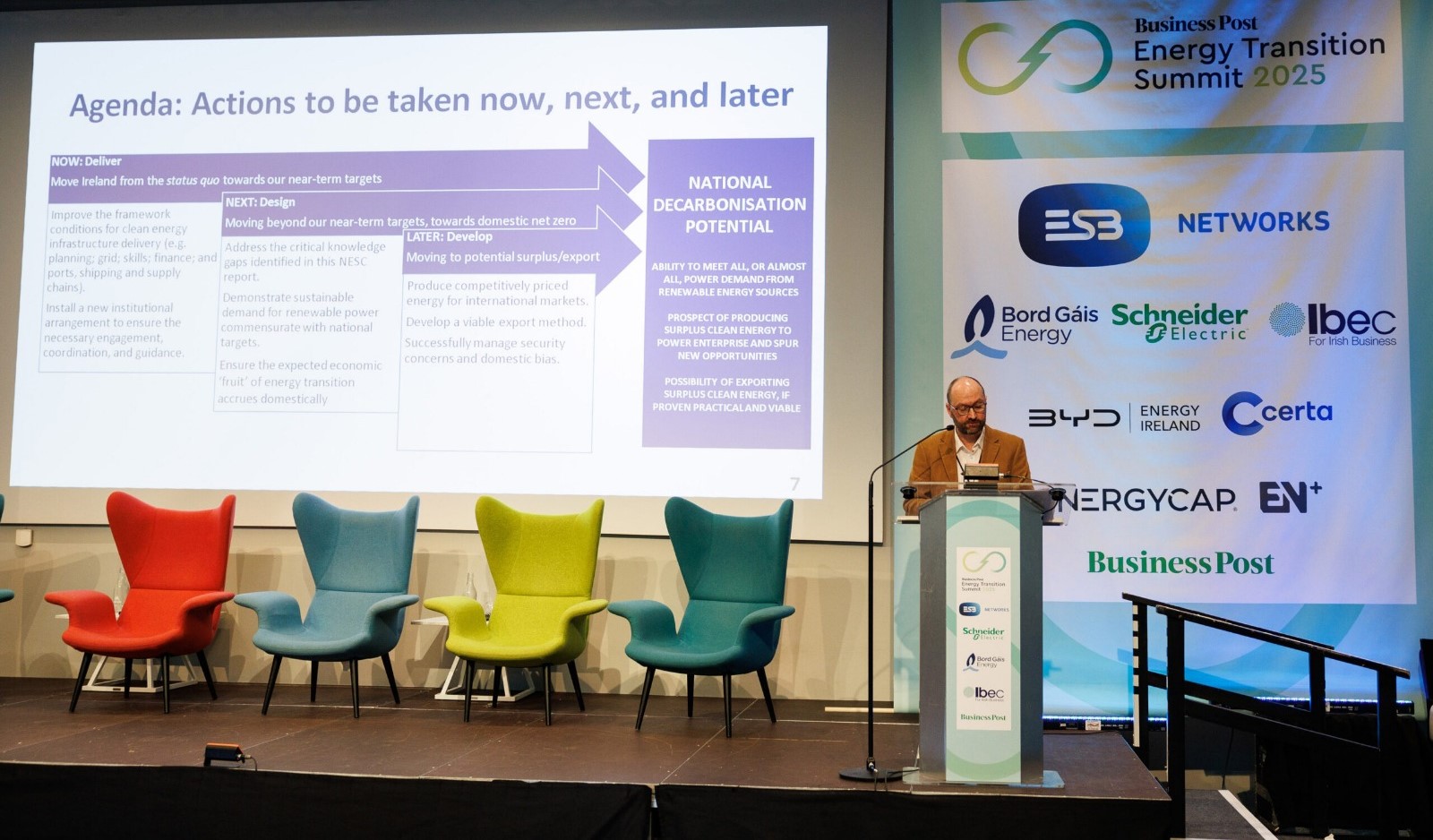
    On Wednesday 15th October, Dr Cathal FitzGerald (Senior Analyst at NESC) told the National Energy Summit 2025 that the National Economic and Social Council has identified key risks to energy transition policy and has set out an agenda to respond to them, categorised into actions for now, next, and later.

    The summit in Croke Park, Dublin brought together 300 experts from industrial, policy, and NGO sectors.

    “A core element of Ireland’s transition is the plan for the power sector. The national narrative is that we can achieve a clean, reliable, affordable power system and one which supports our economy. This was the subject of NESC’s report, Ireland’s Future Power System and Economic Resilience,” Dr FitzGerald told the event. “But there are significant policy and narrative risks. Much of Ireland’s transition policy is headed ‘into fog’ and may be off course. Further, because the cost of electricity is likely to be higher, not lower, and because we are likely to miss our near-term targets, there is a real threat to the narrative,” he stated.

    “NESC has set out detailed actions to address these risks,” he said. “Crucially, Ireland needs a clearer model of our planned transition. A dashed line from where we are, to where we want or need to be, is not a pathway. A meaningful pathway must be traversable and feasible. We need an agreed decarbonisation pathway aligned with national environmental, social, and economic objectives. Otherwise, we can expect more delays and increasing tensions.

    “Complexity and uncertainty around the transition is expected, but this must not lead to paralysis or delay. The Council believes Ireland must act now to deliver where we have visibility and move Ireland from the status quo toward our near-term targets. We must act next to design the way forward where there is fog, moving beyond near-term targets toward domestic net zero. And we must act later to develop a path where there is currently no visibility, moving closer to realising any export potential.

    “This is more than a modelling challenge. The transition must make sense at ground level – socially, economically, and politically – as well as on a graph. Ultimately, Ireland needs a story of energy transition that isn’t told looking 30,000 feet away, looking to the horizon. We need meaningful action now along an agreed pathway to deliver Ireland’s decarbonisation potential,” he concluded.

    You can view Dr FitzGerald’s presentation by clicking here.

  • NESC Participates in Limerick Chamber’s Energy on the Estuary Summit 2025

    NESC Participates in Limerick Chamber’s Energy on the Estuary Summit 2025

    Photo credit: Joanne Collins


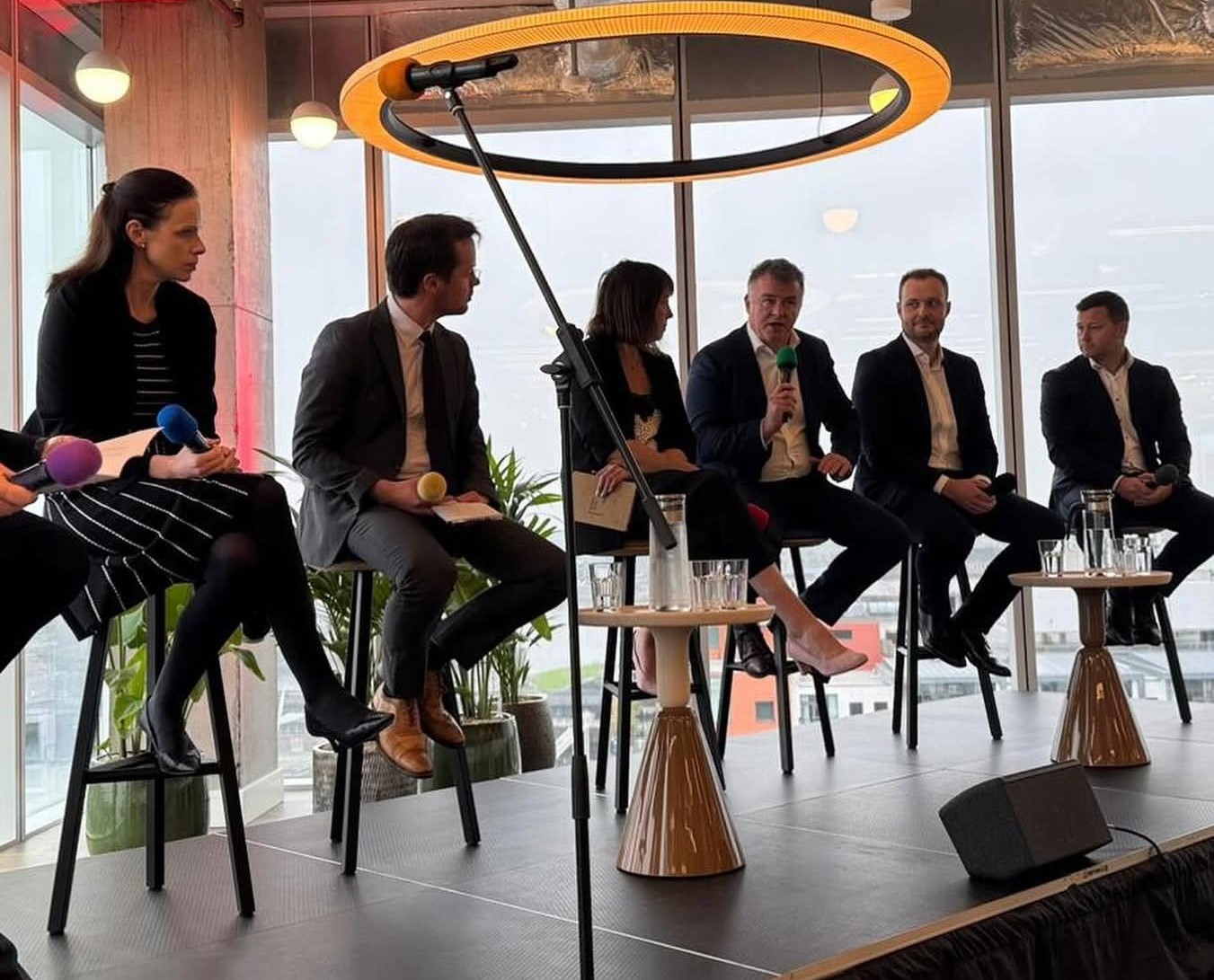
    NESC Policy Analyst Dr David Hallinan took part in a panel discussion at the Energy on the Estuary Summit in Limerick on Monday, October 13th. Opening with an address from Minister of State for Climate, Energy and the Environment Timmy Dooley, the summit focused on the Mid-West region’s potential to contribute to Ireland’s 2030 renewable energy targets and how to achieve long-term competitiveness from an energy perspective.

    The panel discussion David participated in was focused on the topic of enabling the transition through strategic investment and associated public policy considerations. The panel discussed issues such as the plan-led approach to offshore wind and the national Designated Maritime Area Plan (DMAP), the role of large energy users (LEUs) as ‘demand anchors’, how to make Ireland attractive to investors, skills needs, and the goal of maintaining competitiveness.

    David emphasised the need to place a strategic focus on containing costs in the ORE sector, as well as the importance of timely investment in port infrastructure to ensure the smooth operation of global supply chains. David also discussed what is needed from a policy perspective with reference to the forthcoming large energy user (LEU) regulatory framework and the private wires policy.

  • NESC Hosts Dialogue on Power Sector Decarbonisation

    NESC Hosts Dialogue on Power Sector Decarbonisation

    Difficult and Urgent Tasks on Path to Power Sector Decarbonisation, NESC Roundtable Hears

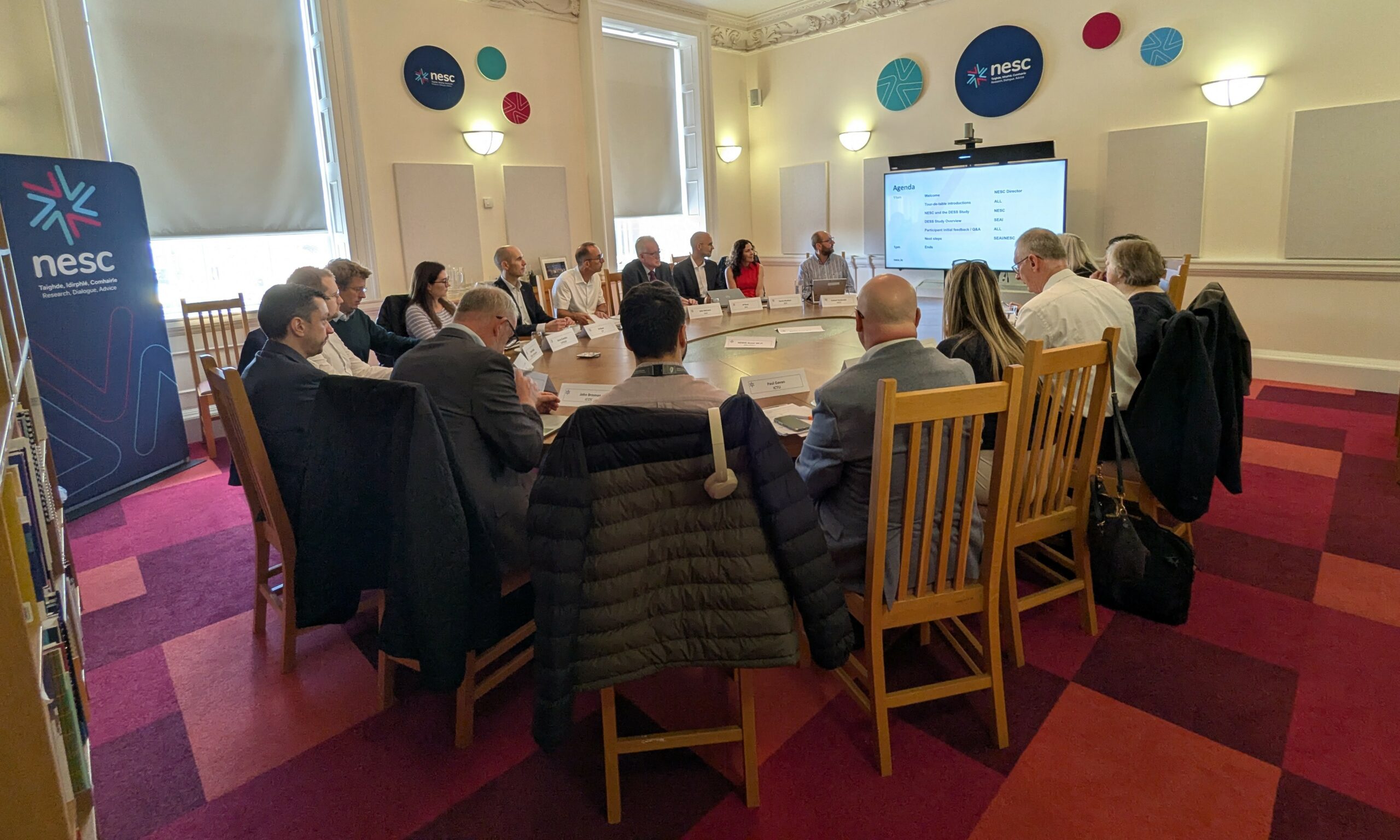
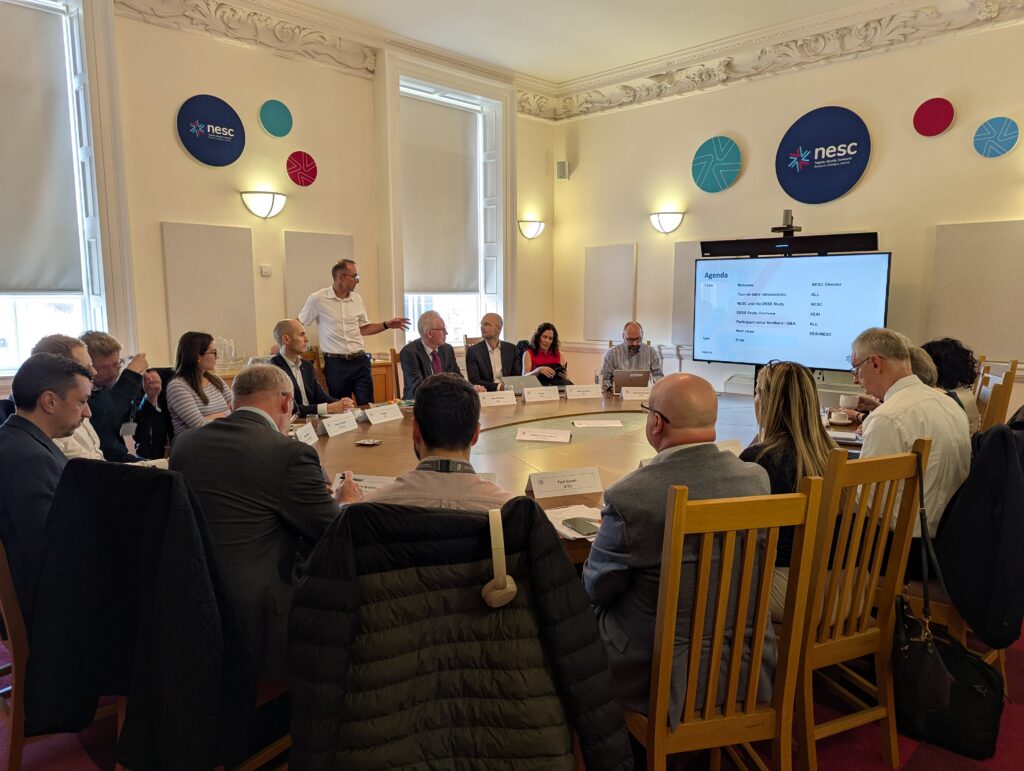
    The National Economic and Social Council (NESC) convened policy experts and researchers on 8th September 2025 to consider an agreed pathway to a decarbonised power system for Ireland.

    Twenty representatives from the government, business, workers, environmental, agriculture, and community sectors heard presentations from NESC and the Sustainable Energy Authority of Ireland (SEAI) about how to further reduce emissions from electricity generation over the coming years.

    Dr Cathal FitzGerald, Senior Analyst at NESC who chaired the gathering, said the process was a central element of climate action in Ireland and that it was crucial that an agreed pathway was identified and followed.

    “Key to reducing harmful emissions is to decarbonise electricity and to electrify as much as possible, in terms of heat, transport, residences, and industry. The Council’s research [read here] has found that Ireland lacks a clear, agreed decarbonisation pathway that aligns national economic, social, and environmental objectives. Agreeing such a path is key to making the energy transition more likely, and more likely to be successful,” Dr FitzGerald said.

    Under the Government’s Climate Action Plans, SEAI is to report on an evidence-based decarbonisation pathway for the electricity system, including a stakeholder consultation, to support future policy. SEAI is therefore undertaking the Decarbonised Electricity System Study.

    “As part of SEAI’s important work, technology options – whether it’s solar PV, onshore and offshore wind, hydrogen, etc. – must be assessed against economic, technical, environmental, and socio-political criteria,” Dr FitzGerald stated. “This is a difficult but urgent task, and NESC’s role of providing research, dialogue, and advice on strategic issues can help.”

    The gathering discussed the screening and scoring of technologies, assessment criteria, and the application of values to inform multi-criteria analysis to be completed in Q1 2026. Emerging issues included messaging, inclusivity, distributional issues, deliberative processes, and feasibility.

  • Energy Communities in Ireland: Progress, Challenges and Potential

    Energy Communities in Ireland: Progress, Challenges and Potential

    This paper expands on the findings of NESC Council Report No.170 Connecting People to the Energy Transition. It provides a more detailed discussion of the energy communities findings, with additional material and examples. It examines the current practices of energy communities and recent developments to understand the state of play in Ireland. Also discussed is the policy context that has enabled the growth in the number of energy communities in the EU and nationally.

  • Council Report No.170 – Connecting People to the Energy Transition

    Council Report No.170 – Connecting People to the Energy Transition

    Putting People at the Centre is Key to Ensure a Just and Fair Energy Transition

    12th August 2025, Dublin, Ireland: A new report by the National Economic and Social Council (NESC) focuses on how to better connect people to a changing energy system so that it is just and inclusive.

    Based on in-depth research and consultations with households, energy communities, policy makers and research experts, the Council finds that while the energy transition is technically underway, its meaning and impact for individuals, households and communities remains unclear. The Council argues that the specific ‘ask’ of the people in Ireland regarding the transition has yet to be clearly defined. It identifies a range of challenges to be addressed, including:

    • Energy affordability and the persistent issue of energy poverty for vulnerable groups;
    • Households face barriers to energy efficiency action including high upfront costs, complex grant processes, uncertainty and practical issues;
    • Households are largely ‘in the dark’ about their energy use and are not yet benefiting from some of the new opportunities from electricity usage such as dynamic tariffs and energy sharing; and
    • Extreme weather events are highlighting the need for energy resilience at a local level. Energy communities are being supported but are finding barriers to delivering projects to generate energy.

    Speaking about the report, NESC Policy Analyst Dr Jeanne Moore said: “Individuals, households and communities can potentially play a very significant and immediate role in making energy savings, generating renewable energy and building energy resilience if enabled to do so. However, these opportunities and benefits are not yet available to all.”

    To address this, the Council calls for a fundamental shift, urging policy and practice to place people firmly at the centre.

    The Council outlines a range of actions, in each of these areas, to support a just energy transition. Placing people and their wellbeing at the centre of the energy transition can help to ensure the transition is just, fair, equitable, and inclusive.

    The Council argues the success of Ireland’s energy transition hinges on deliberately strengthening various connections between people and the energy system. Key recommendations from the report include:

    • Protecting Households and Ending Energy Poverty: Safeguards for affordability and wellbeing must be prioritised to protect households, particularly vulnerable groups, from price volatility and energy poverty. An integrated approach is needed to make ending energy poverty a priority.
    • Strengthening Governance for a Just Transition: This requires further engagement, collaboration and potentially developing a shared vision or “galvanising mission” through participative approaches. Addressing the long-term costs of the transition and how they will be shared is crucial and requires a clear approach beyond consumer bills.
    • Barriers to Clean Heat and Energy Efficiency Need to be Addressed: Scaling up energy efficiency and transitioning to clean heat (like heat pumps and district heating) requires addressing barriers needed to support increased uptake. Leveraging social and behavioural insights to make energy efficiency simpler, using trusted messengers and local leaders, and supporting group delivery schemes (such as Solar Meitheals) are required.
    • Households Can be Active Participants: Households can become more active participants (“energy citizens” or “prosumers”) through demand-side management, microgeneration, and energy sharing. Increased measures to ensure equitable access for all could be supported by secure application of digital/AI technologies.
    • Building Local Energy Resilience: A regional/local approach, involving local authorities and communities, can enhance local energy resilience and support decarbonisation. Building local energy resilience can be enabled through use of batteries and resourced community hubs.
    • Energy communities Can Play a Key Role: There are growing numbers of energy communities in Ireland, and they want to do more. Addressing barriers, measures should expand ownership models (e.g., co-ownership with developers or potentially with public bodies/local authorities), provide better early-stage funding, supporting communities to act as intermediaries for households, and facilitate their role in local heat generation (biogas, district heating) and energy sharing.

    On the publication of the report, Dr Larry O’Connell, Director of NESC, added that: “The Council believe that strengthening the connection between people and the energy transition is essential for a just, inclusive, and wellbeing-focused outcome. Putting people at the centre, ensuring affordability, fostering local action and resilience, and supporting communities are essential for a successful and just transition that benefits all. This involves equitable sharing of costs and benefits, protecting vulnerable groups, and fostering collaboration across society.”

    This report is the third to be published in 2025, from a body of work on the topic of energy policy.

    To read the report in full please click here.

    ENDS

    For further information, contact:

    Marie Lynch, Carr Communications,

    e: marie@carrcommunications.ie | m: 087 973 0522
  • Connecting People to the Energy Transition

    Connecting People to the Energy Transition

    Ireland is undertaking a large-scale transformation of its energy system, moving from fossil fuels to largely renewable sources to achieve climate neutrality by 2050. With legal targets to be achieved and a widening gap between current progress and required reductions, the Council recognises that this is a societal as well as economic and technological challenge. The transition must ensure that emissions are reduced while also protecting energy security, affordability and reliability for people. There will be costs and risks; some people will be more affected than others.

    There are challenges in delivering a just transition and there are new risks to energy reliability, highlighted by extreme weather events. In this report, the Council recognises that this transition must be just, ensuring equitable distribution of costs and benefits while protecting vulnerable groups. Adopting a societal lens is crucial for understanding how households are connected to the energy system and strengthening this connection for successful implementation.

    The Council focuses on five broad areas where actions can be taken, as detailed in this report:

    • Energy Affordability, Energy Poverty, Monitoring and Targeting;
    • Scaling Energy Efficiency and Clean Heat;
    • Helping Households Reap Electricity Benefits;
    • Place-Based Energy Resilience and Local Production; and
    • Strengthening Energy Connections.

    A more detailed discussion of this report’s findings on energy communities specifically can be found in Secretariat Paper No.38, Energy Communities in Ireland: Progress, Challenges and Potential.

  • International Trade Dependencies and the Energy Transition

    International Trade Dependencies and the Energy Transition

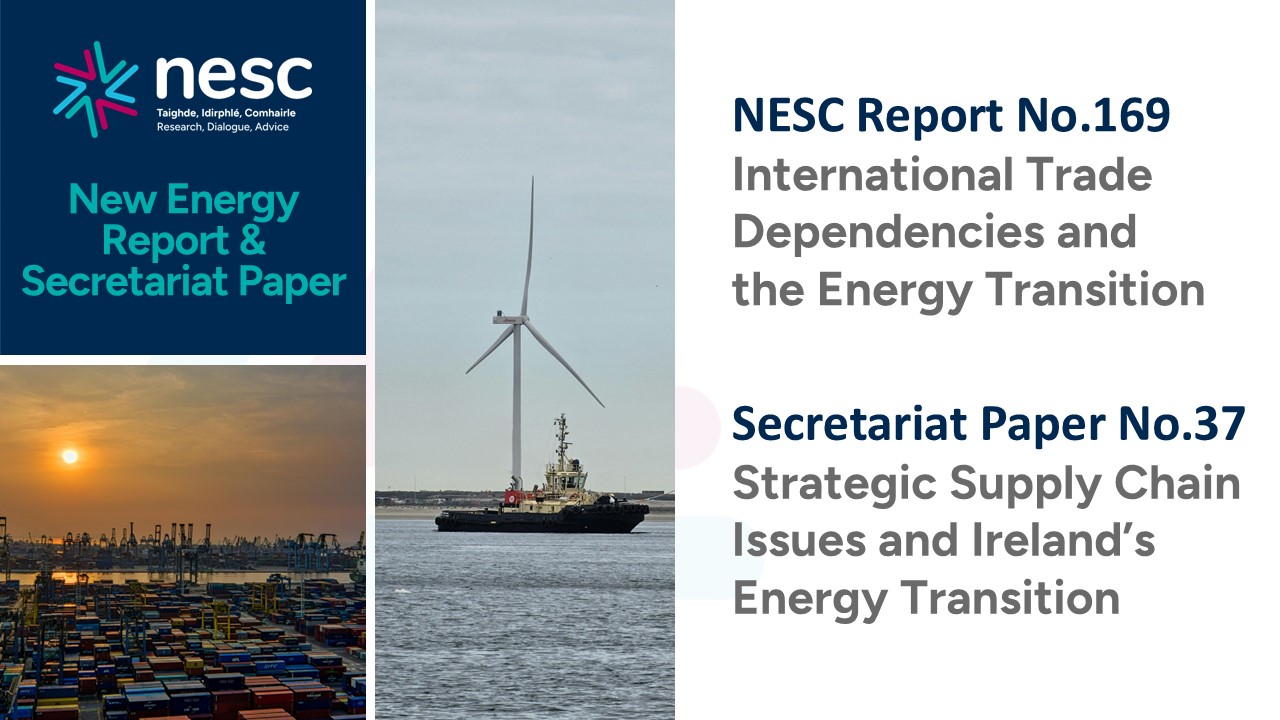
    This report examines Ireland’s international trade dependencies in the energy sector and how these will evolve over the course of the energy transition. Ireland is currently among the most fossil fuel import-dependent countries in Europe. This reliance on imported fossil fuels presents several disadvantages including high levels of CO2 emissions, exposure to supply disruptions and price volatility on international markets, financial outflows, inefficient fossil-fuel subsidies, and negative impacts on air quality and human health.

    This report provides recommendations and policy actions to address strategic policy issues relating to the international trading environment in the energy sector, enabling us to better adapt to factors beyond our borders that will shape the energy transition. Five strategic recommendations are put forward by the Council.

    Accompanying this report is a supplementary NESC Secretariat research paper titled Strategic Supply Chain Issues & Ireland’s Energy Transition, which examines three thematic areas: the international wind technology supply chain; carbon emissions embedded in trade; and the international biofuel supply chain.

  • Strategic Supply Chain Issues & Ireland’s Energy Transition

    Strategic Supply Chain Issues & Ireland’s Energy Transition

    This paper expands on the findings of the NESC Council Report International Trade Dependencies and the Energy Transition (No.169). It explores strategic supply chain issues that are central to the successful delivery of Ireland’s climate and energy objectives – while Ireland possesses abundant natural resources for renewable energy, particularly in the form of wind, our capacity to develop and deploy these resources at scale is increasingly shaped by global supply chain dynamics, geopolitical developments, and international trade relations. The cost, availability, and sustainability of key technologies and resources such as wind turbines, solar panels, and biofuels are not solely determined by national policies, but by cross-border supply chains, trade policy developments at EU-level, and evolving international regulatory frameworks.

  • Council Report No.169 – International Trade Dependencies and the Energy Transition

    Council Report No.169 – International Trade Dependencies and the Energy Transition


    NESC Report Highlights Challenge of Transforming Ireland’s Energy Trade

    • Ireland’s fossil fuel import-dependency is a strategic vulnerability.
    • Cost-competitiveness challenges must be addressed if Ireland is to become a significant net exporter of renewable energy.
    • The outlook for the green hydrogen sector remains uncertain, but strengthening international strategic partnerships can support its development.


    30th July 2025, Dublin, Ireland: Ireland faces cost-competitiveness challenges that must be acknowledged and addressed if the country is to become a significant net exporter of renewable energy. That’s the key message in a new report from the National Economic and Social Council (NESC) which examines how Ireland’s energy trade will evolve over the energy transition, moving away from reliance on imported fossil fuels towards a more complex and interdependent European energy system based on renewables.


    “The energy transition will not insulate us from developments beyond our borders,” said Dr David Hallinan, Policy Analyst at NESC. “Ireland is an island—but we’re part of a European energy system. The international trading environment and domestic energy system will remain deeply intertwined. To lead in clean energy, we need to invest strategically, contain costs, and work more closely with our neighbours.”

    Ireland is currently among the most fossil fuel import-dependent countries in Europe, exposing households and businesses to price volatility on international markets and geopolitical risks. Unless reliance on imported fossil fuels is dramatically reduced, Ireland risks worsening climate change and substantial EU fines. The report recommends redirecting fiscal resources away from inefficient fossil fuel subsidies to accelerate the energy transition and shift economic incentives toward investment in renewables.

    Events such as the war in Ukraine and conflict in the Middle East highlight the need for strategic energy reserves to act as a buffer in the event of a major prolonged disruption to international energy supplies. The report proposes that Ireland should formulate a long-term national plan for strategic clean energy reserves based on zero-carbon fuels such as green hydrogen and biomethane, in line with national commitments to decarbonise the energy system.

    Recent data cited in the report shows that electricity exports from Ireland have fallen in recent years, while imports have surged. The primary driver of this has been the availability of cheaper electricity imports from Great Britain. As Ireland’s interconnector with France will become operational in 2026, the availability of cheap electricity imports will increase further. Ireland’s electricity is more expensive than in these larger markets due to a combination of factors, including a high degree of reliance on natural gas, grid bottlenecks, geographic isolation, and the absence of nuclear power. Ireland’s ambition to become a major net exporter of renewable electricity risks being undermined unless policymakers act swiftly to address cost competitiveness challenges.

    Green hydrogen is another pillar of Ireland’s decarbonisation strategy and renewable energy export potential, mainly focussed on decarbonising hard-to-electrify sectors. The report cautions that the outlook for the sector remains uncertain and points out that domestic hydrogen demand alone will not justify large-scale infrastructure investment. Without guaranteed export pathways and demand certainty, green hydrogen risks becoming another stranded asset. Ireland will need to develop strategies for cost-competitive green hydrogen production while fostering strategic partnerships with countries that will be significant importers of green hydrogen in future.

    The report also highlights the need to place a strategic focus on maximising domestic use of Ireland’s vast renewable energy resources to achieve strategic resilience, industrial decarbonisation, and to meet legally binding emissions reduction targets.


    Dr Hallinan added: “Ireland must not view itself in isolation. Our energy future is European, and it must be built on shared planning, shared investment, and shared ambition. We will remain deeply interdependent through trade in electricity, trade in zero carbon fuels, trans-national infrastructure, and trade in renewable energy technologies.

    “The race to become a global leader in renewable energy trade will not be won on policy ambition alone. There are real concerns about the slow pace of energy infrastructure delivery. Projects to expand the grid, develop offshore wind farms, and upgrade port infrastructure are moving too slowly.

    “Future investment decisions must be supported by European frameworks for joint planning and cost-sharing, as well as strategic partnerships with countries that will be significant importers of renewable energy commodities in future. These mechanisms are vital to ensuring Ireland’s renewable energy exports can be sold into European markets competitively and reliably.

    “If Ireland is to realise its ambition of becoming a significant net exporter of renewable energy commodities, we must address the root causes of high domestic electricity prices. Our ability to export clean energy will depend on how effectively we address these fundamentals.”


    On the publication of the report, Dr Larry O’Connell, Director of NESC, added that: “Ireland has the natural resources and the policy ambition to become a clean energy powerhouse, but this potential will only be realised if policymakers address serious structural challenges head-on. What we need is a coordinated national response that integrates energy, trade, security, and industrial policy.”

    This NESC report is the second to be published in 2025, from a body of work on the topic of energy policy (as part of our strategic outcome to reframe, refresh and improve current policy options).


    To read the report in full please click HERE.

    Also being published today is a supplementary NESC Secretariat research paper titled Strategic Supply Chain Issues & Ireland’s Energy Transition, which examines three thematic areas: the international wind technology supply chain; carbon emissions embedded in trade; and the international biofuel supply chain – you can access it now by clicking here.


    ENDS


    For further information, contact:

    Marie Lynch, Carr Communications,

    e: marie@carrcommunications.ie | m: 087 973 0522